

We have all sat through stale corporate workshops, where the coffee goes cold, the air conditioning hums relentlessly, and the collective will to live slowly drains from the room. Someone stands at the front of a boardroom in Sandton, clicks through an endless slide deck, and demands that the team “innovate“.
The result is almost always the same: a whiteboard full of generic buzzwords, a team that feels more exhausted than inspired, and zero commercial traction. We see this happen constantly across the South African business landscape.
There is, however, a more effective way to work. High-energy workshops are not about forced fun or awkward icebreakers, but about creating the right conditions for creativity to become a more consistent and repeatable outcome. When the energy in the room is managed well, ideas flow more freely and creativity becomes far easier to unlock.
Innovation is not a passive activity, because it requires friction, debate, and a significant amount of cognitive fuel. Without a baseline of energy in the room, the creative process simply stalls.
Many organisations operate under the illusion that creativity can be scheduled like a compliance meeting. They block out two hours on a Friday afternoon and expect groundbreaking ideas to miraculously appear. This approach ignores the reality of human behaviour.
When professionals are under looming deadlines, their brains tend to default to safe, predictable thinking, which is exactly why great ideas cannot be forced out of a tired mind. True creative strategy requires a departure from the ordinary, and that departure demands energy.
When a room is energised, energy acts as a catalyst for cognitive flexibility and makes participants far more likely to take intellectual risks. They speak up, they challenge the status quo, and they build on the ideas of others.
This dynamic is the foundation of effective design thinking, because high energy levels lower our natural defensive barriers. Instead of shooting down a new concept because it sounds difficult to implement, an energised team will ask how they can make it work. The conversation shifts from finding problems to designing solutions.
The financial impact of a bad workshop becomes staggering when you calculate the hourly rate of ten senior decision-makers sitting in a room for a full day. If that session yields nothing but polite nods and a few sticky notes, it is a massive waste of capital.
Beyond the immediate financial cost, flat workshops breed cynicism. When teams are repeatedly dragged into low-engagement innovation sessions that lead nowhere, they stop trying. They learn that these workshops are just a box-ticking exercise, completely detached from real commercial outcomes.
Although the phrase “creativity on demand” sounds like a contradiction, commercial creativity is not some mysterious spark that strikes without warning. We know that it is actually a highly structured discipline.
You do not command ideas to appear, but instead build the ecosystem that allows them to surface naturally. This starts with the physical and mental environment. A cramped, windowless meeting room in a corporate park is not conducive to expansive thinking.
The space must encourage movement, the agenda must allow for mental breathing room, and daily operational distractions must be actively removed to stop people from staying anchored to their immediate to-do lists.
Energy cannot exist where fear dominates, because people will always withhold their best insights when they feel exposed. If a junior staff member is terrified of sounding foolish in front of the executive team, they will hold back. Building psychological safety in the first twenty minutes of a session is crucial.
Once safety is established, we can build momentum, which creates a sense of progress. When a team sees their raw thoughts rapidly visualised and organised, they feel a sense of achievement. This small win generates more energy, creating a powerful feedback loop of collaborative creativity.
Total freedom often feels paralysing in a workshop setting, especially when a team is handed a blank sheet of paper and told to solve a complex business problem. Creativity thrives under constraints.
We use specific frameworks to guide the creative process without suffocating it. A well-designed workshop relies on clear boundaries to keep the thinking sharp.
A workshop is only as good as its facilitator. Facilitation is an active, demanding discipline that requires high emotional intelligence, sharp commercial acumen and a lot of energy. Put simply everything in a workshop is an energy exchange and if the facilitator doesn’t give any, they will definitely not get any in return.
The best facilitators act like the bumper lanes in a bowling alley, making sure the team’s ideas do not end up in the gutter without throwing the ball for them. We provide the framework, but the team provides the content.
If a facilitator talks too much, they drain the room, which is why the real skill lies in asking the right questions, provoking new angles, and then stepping back. We are there to manage the process, not dictate the outcome.
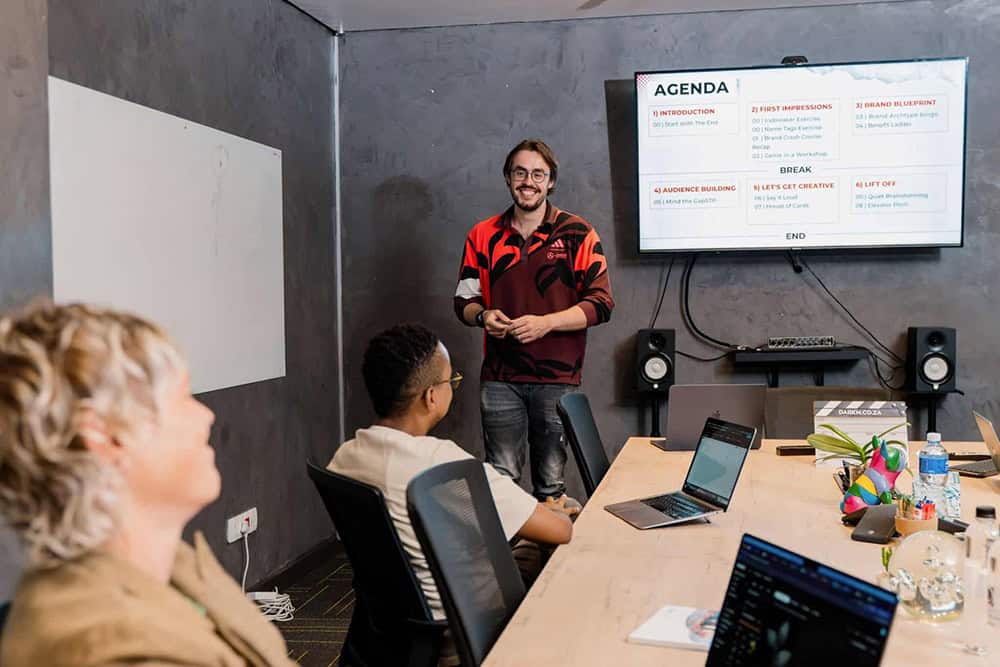
No workshop should go exactly according to the planned agenda, because energy levels naturally fluctuate throughout the day. The classic post lunch slump is a biological reality that every facilitator must navigate.
We must constantly read the room, and if eyes are glazing over, it is time to pivot. We might scrap a planned sit-down exercise and switch to a rapid, stand-up ideation sprint. Agility in facilitation is what keeps the momentum alive when the natural energy dips.
Creative minds love to wander, which means a discussion about a new digital product can quickly derail into a debate about the company’s outdated IT infrastructure. While these tangents are sometimes valuable, they can also derail the entire objective.
We use tools like “the parking lot” to capture valid points that are off-topic without sacrificing the session’s focus. This acknowledges the contributor’s input while still protecting the agenda. It is a delicate balance of validating ideas while ruthlessly protecting the core objective.
Great workshops are designed like great stories, with an engaging opening, a challenging middle, and a satisfying, actionable conclusion. The architecture of the day dictates the quality of the output.
South African corporate culture is generally pragmatic, which means you will lose the room immediately if activities feel too childish or disconnected from reality. Every activity must have a clear, logical link to the business problem.
Instead of relying on generic trust exercises, we use rapid-fire problem-solving games that activate the brain through quick decisions and lateral thinking. The goal is to get participants out of their comfort zones quickly but respectfully.
A high-energy workshop cannot be a non-stop adrenaline rush, because if you push a team too hard for too long, they will burn out before lunch. The design must incorporate natural rhythms.
We alternate between intense bursts of collaborative “doing” and quiet periods of individual “thinking”, because reflection is a critical part of the creative process. Giving people ten minutes of silence to process the morning’s chaos often yields the most profound strategic insights.
The biggest failure of any workshop is the lack of follow-through. Everyone leaves feeling inspired, but by Monday morning, the energy has evaporated and nothing changes. We must bridge the gap between ideation and execution.
To ensure a workshop delivers commercial value, we always end with strict alignment on the next steps.
When you master the art of the high-energy workshop, the benefits extend far beyond the ideas generated on the day. It fundamentally changes how a team operates.
Traditional top-down strategy rollouts often face massive internal resistance, because people naturally push back against changes they had no part in creating. High-energy workshops solve this by democratising the creative process.
When stakeholders from different departments sweat through a tough problem together, they align much faster. The friction of the workshop replaces the friction of implementation. They leave the room with a shared understanding of why a specific direction was chosen.
There is a profound psychological shift when a team transitions from executing “management’s plan” to executing “our plan”. High-energy workshops foster this sense of deep ownership.
Because the team fought for the ideas, debated them, and refined them, they are deeply invested in seeing those ideas succeed. This emotional investment is the difference between a project that barely survives and one that thrives.
Ultimately, a strategy is only as good as its execution. The momentum generated in a brilliant workshop does not just vanish. It acts as a propellant that launches the project into the real world.
By turning complexity into commercial clarity, we give teams the confidence to move forward. They are no longer bogged down by ambiguity. They have a clear vision, the energy to pursue it, and the strategic framework to make it a reality.
Want to turn your team’s collective energy into commercial execution? If you are ready to stop wasting hours in flat meetings and start building strategies that actually work, we should talk.