
There is a pervasive myth in the business world that integrated marketing is simply about ubiquity. Many organisations believe that to be “integrated” means to be everywhere at once. They launch a campaign that copies and pastes the same creative asset across LinkedIn, Instagram, email newsletters, and out-of-home billboards. Then they wait for the leads to roll in.
We often see the result of this approach. It is not clarity. It is noise.
True integrated marketing is not about shouting the same message through every available megaphone. It is about alignment. It is the practice of ensuring that every touchpoint a customer has with your brand reinforces a singular, coherent narrative. However, you cannot construct that narrative if you do not know who you are speaking to or what they actually care about.
In the complex and diverse South African market, where consumer behaviour shifts rapidly between informal economies and high-tech digital adoption, assumptions are expensive. This is why we argue that effective integrated marketing is not an exercise in broadcasting. It is an exercise in listening.

Before we can fix the strategy, we must diagnose the misunderstanding. The term “integrated marketing” has become a buzzword that often disguises a lack of focus. When brands try to be everything to everyone, they end up being nothing to anyone.
We frequently encounter strategies that are defined by the tools they use rather than the problems they solve. A marketing director might ask, “What is our TikTok strategy?” before asking, “Is our audience even on TikTok?”
Integration is often reduced to a checklist of channels. The logic follows that if the logo appears on five different platforms, the marketing is integrated. This is a logistical achievement, not a strategic one. Real integration is about the seamless connection of the consumer experience, not the simultaneous activation of media distinct channels.
When execution leads strategy, budget wastage is inevitable. We see brands pouring resources into high-production video content or expensive programmatic advertising without a clear understanding of the message’s intent. This is execution-first marketing.
It prioritises the “how” over the “who” and the “why”. In a resource-constrained economy like South Africa, where every Rand of marketing spend needs to demonstrate ROI, execution-first approaches are a liability. They generate vanity metrics – views and likes – but rarely drive the deep commercial traction that comes from genuine resonance.
The digital ecosystem is crowded. If your integrated campaign is simply blasting generic messaging across multiple touchpoints, you are contributing to the noise. Without insight, your marketing is just an interruption.
Consumers are adept at tuning out irrelevant information. If your email marketing says one thing, but your sales team says another, and your social media reflects a third reality, the customer creates a mental barrier. They disengage. To cut through the noise, you do not need more volume. You need more precision.

If we agree that shouting is ineffective, we must pivot to listening. This is not a passive activity. In the context of marketing strategy, listening is an active, data-driven pursuit of truth.
Listening first means delaying the creative output until the strategic input is solidified. It involves auditing the current landscape to understand where the brand actually sits in the mind of the consumer, versus where the boardroom thinks it sits.
This involves:
Context is everything. A campaign that works in London or New York often fails in Johannesburg or Cape Town because the cultural and economic context is different. South African consumers are value-conscious, brand-loyal yet sceptical, and highly digitally literate despite infrastructure challenges like connectivity issues.
We must listen to these nuances. Are your customers accessing your content via mobile data? If so, a 4K video header on your website is not an asset; it is a barrier. Are they looking for aspirational lifestyle content, or are they looking for practical solutions to economic pressure? Listening reveals these realities.
The most dangerous phrase in a strategy meeting is “I think.” We prefer “The data suggests.”
Moving from assumptions to insight requires a rigour that many avoid because it takes time. However, this upfront investment prevents costly pivots later. Insight tells us not just that a customer bought a product, but why they bought it. Did they buy it because of the price, the brand promise, or a specific feature? Once we know the “why”, we can integrate that truth across every channel.
Once we have listened and gathered the necessary customer insights, we can begin the work of integration. This is where the strategy moves from abstract data to concrete action.
True integration creates a “red thread” that weaves through every interaction. This thread is your core value proposition. Whether a customer reads a blog post, sees a paid ad, or speaks to a consultant, the core message must remain stable.
The tone may adapt – LinkedIn is professional, Instagram is visual, email is personal – but the substance cannot change. When we align the brand promise with the channel delivery, we create a compounding effect. The customer recognises the brand instantly, regardless of the platform.
Inconsistency usually stems from a lack of confidence in the message. When brands are unsure of what their audience wants, they try a different personality every week. One week they are humorous; the next they are serious corporate advisors.
When you have listened to your audience, you have the confidence to be consistent. You know what resonates. This consistency builds authority. In a market where trust is hard to earn, being a reliable, consistent voice is a competitive advantage.
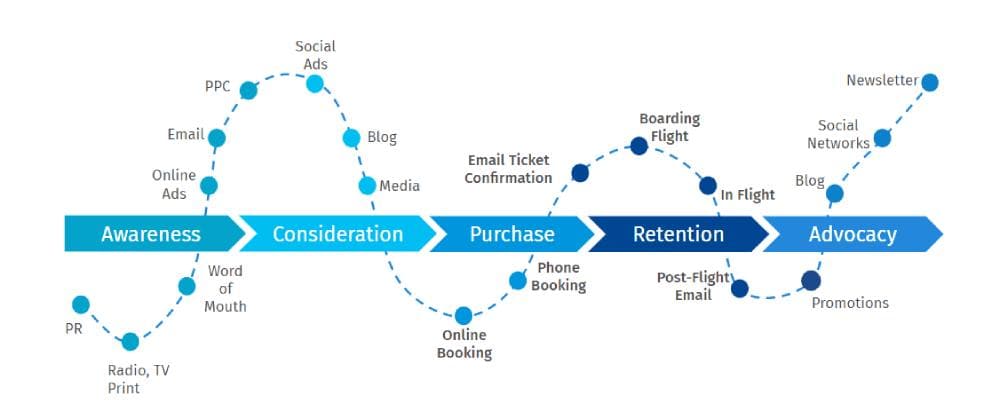
Campaigns have start and end dates. Customer relationships do not. We believe in designing integrated journeys rather than isolated campaigns.
A journey considers the long-term lifecycle of the customer. It asks:
Listening helps us map this journey accurately. We can identify where customers drop off and use integrated tactics to bridge those gaps.
With a strategy in place, execution becomes surgical. We stop spraying and praying, and start targeting with intent.
Not every brand needs a podcast. Not every B2B company needs to be on Facebook. Channel selection should be dictated by audience behaviour, not industry trends.
If our listening phase reveals that our target decision-makers spend their mornings reading financial news and their evenings on LinkedIn, that is where we focus. We ignore the rest. This efficiency is the hallmark of a mature marketing strategy. It saves budget and increases impact.
Content strategy is the fuel of integrated marketing. However, alignment does not mean duplication. You should not post a press release on Instagram. Instead, you take the core insight of the press release and translate it into a visual story.
We ensure that the content speaks the native language of the platform while delivering the universal message of the brand. This requires a content engine that is agile and capable of repurposing core insights into various formats – video, text, audio, and static imagery.
There is nothing worse for a consumer than a fragmented experience. Imagine clicking on an ad promising a discount, landing on a page that doesn’t mention it, and then receiving a welcome email that treats you like a stranger.
This fragmentation kills conversion. By listening to the data flow between these points, we can smooth out the friction. Integration means the left hand always knows what the right hand is doing. The data from the ad must inform the landing page, which must trigger the correct email sequence.
Ultimately, the goal of this approach is commercial clarity and growth. Listening is not just a “nice to have” soft skill; it is a revenue driver.
When you speak directly to a customer’s specific pain point or desire, they pay attention. Relevance captures attention far better than volume. By basing our integrated marketing on listening, we ensure that every piece of content strikes a chord. Engagement rates rise because we are contributing value, not just noise.
In South Africa, consumers support brands that support them. When a brand demonstrates that it listens – by responding to feedback, adapting to economic shifts, and providing relevant solutions – it builds trust.
Trust is the ultimate retention tool. A customer who feels heard is a customer who stays. Integrated marketing that focuses on two-way communication rather than one-way broadcasting fosters this loyalty.
Finally, listening changes how we measure success. We stop obsessing over “reach” and “impressions” – metrics that can be bought. We start measuring “share of heart” and “lifetime value”.
We look at sentiment analysis, repeat purchase rates, and referral traffic. These are the indicators of a healthy, integrated brand. They prove that the strategy is working not just to get attention, but to keep it.The era of “shout louder” marketing is over. The brands that win today are the ones that stop, listen, and then execute with precision. If you are ready to stop adding to the noise and start turning your customer insights into commercial revenue, we should talk. Chat Now